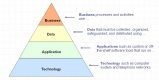
Enterprise Architecture Overview Training Course
This course is for everyone involved in planning, analysing, implementing, executing, maintaining or improving Enterprise Architectures. It shows comprehensive perspective of tools used to describe and implement the EA.
This course is available as onsite live training in China or online live training.Course Outline
Introduction to Enterprise Architecture
- What is architecture
- Enterprise Architecture (EA)
- Why do we need EA
- IT Enterprise Architecture
- Business Enterprise Architecture
- Enterprise Architecture Description vs EA Implementation
Enterprise Architecture Methods, Frameworks, Concepts and Paradigms
EA, Governance and Strategic Planning
- Strategic Management, Strategic Planning
- OMG Business Motivation Model
- Strategy Execution (EFQM)
- Quality Management(Six Sigma, TQM, ISO 9001)
- IT Governance
- IT Service Delivery and Support (ITIL)
- IT Implementation (CMM and CMMI)
Methods and Frameworks
- IEEE Standards
- Zachman Framework
- OMG UAF (Unifed Architecture Framework)
- MDA
- SOA
- Nato Architecture Framework, MoDAF, DoDAF, UPDM
Description Languages
- IDEF
- BPMN
- Testbed
- SoaML
- UML
- Architecture Description Languages
- Suitability for EA
Enterprise Architecture Modelling
- Modelling Process
- Readability and Usability of Models
- Viewpoints and Visualisation
Architecture Analysis
- Analysis Techniques
- Quantitative Analysis
- Functional Analysis
Other
- Architecture Alignment
- Tool Support
Need help picking the right course?
Enterprise Architecture Overview Training Course - Enquiry
Enterprise Architecture Overview - Consultancy Enquiry
Testimonials (1)
we write some code in GO and we learn some stuff regarding EDA like events, when and how.
Alin
Course - Event Driven Architecture Custom
Upcoming Courses
Related Courses
SysML by example with Cameo Systems Modeler
21 HoursThis training will teach you how to use SysML, the modeling language for systems engineering. In particular, you will learn about block diagrams for structural modeling of complex systems. You will deepen the sequence diagram, state diagram and activity diagram for dynamic modeling.
You will also learn how to use specific SysML diagrams such as the requirements diagram and the parametric diagram, as well as the concept of allocation. We will also emphasize the need to define a modeling approach, adapted to the business context and the type of system to be studied.
The practice will be done using the Cameo Systems Modeler (MagicDraw) modeling tool from NoMagic.
Teaching method
- Theoretical presentation illustrated with examples
- 50% practical work with Cameo Systems Modeler on a case study throughout the training
Introduction to Domain Driven Design
14 HoursDomain Driven Design (DDD) is an approach for handling complex behaviors when developing software.
Introduction to Enterprise Architect
7 HoursThis Introduction to Enterprise Architect training course is designed for all persons who wish to use Sparx Systems’ UML modelling tool, Enterprise Architect, for their modelling activities yet are unfamiliar with the features, functions and use of Enterprise Architect.
Enterprise Architecture in the UAF
35 HoursUsing a combination of lectures, demos, and interactive labs, this course showcases the foundations for building and maintaining an Enterprise Architecture (EA) utilizing the Unified Architecture Framework (UAF) version 1.2.
Event-Driven Architecture with Go
28 HoursEvent-Driven Architecture (EDA) is a software design approach where decoupled components communicate by producing and consuming events, enabling highly scalable, responsive, and resilient systems.
This instructor-led, live training (online or onsite) is aimed at intermediate-level to advanced-level Go developers who want to learn how to design, build, and deploy event-driven applications using Go and common messaging systems like Kafka, RabbitMQ, or NATS.
Through hands-on labs and real-world examples, participants will gain practical skills in building decoupled services, managing messaging infrastructure, and deploying scalable event-based systems in modern cloud-native environments.
By the end of this training, participants will be able to:
- Understand key concepts and trade-offs in Event-Driven Architecture.
- Design and implement event producers and consumers in Go.
- Use messaging systems like Kafka, RabbitMQ, and NATS with Go.
- Set up and manage event infrastructure using Docker and Kubernetes.
- Apply best practices for error handling, monitoring, and deployment.
Format of the Course
- Interactive lecture and discussion.
- Lots of exercises and practice.
- Hands-on implementation in a live-lab environment.
Course Customization Options
- To request a customized training for this course, please contact us to arrange.
ITIL® 5 Foundation Bridge – Accredited Training with Certification Exam
7 Hours
This training is designed for professionals who already hold an ITIL® 4 Foundation certification and want to update their knowledge to the latest ITIL® 5 framework.
It provides a focused and efficient transition, highlighting the key differences, new concepts, and expanded practices introduced in ITIL® 5.
ITIL® Foundation V5
14 HoursThis training provides a comprehensive introduction to ITIL® 5 - the modern framework for managing digital products and services in today’s fast-changing environments. It equips participants with a solid understanding of how organizations can create value through effective service management and collaboration.
ITSM Fundamentals (ITIL 4-Based)
14 HoursThis instructor-led, live training in China (online or onsite) is aimed at intermediate-level IT professionals and ICT service managers who wish to understand and apply ITSM fundamentals and practices based on ITIL 4.
By the end of this training, participants will be able to:
- Understand key concepts and structure of ITIL 4.
- Apply service design and architecture practices aligned with ITIL 4 principles.
- Implement effective delivery and sustainability of ICT services.
- Evaluate real-world cases and simulate ITSM practices.
OCSMP Model Builder - Fundamentals prep
21 HoursThe OCSMP Model Builder – Fundamental examination tests knowledge and skills required to construct a basic SysML model of a system. The examination covers model concepts and organization, basic requirements capture and management, structure and behavior models, parametric models, allocation relationships, and use of stereotypes. Using the knowledge and skills covered at this level plus familiarity with a suitable SysML modeling tool, a holder of the OCSMP Model Builder – Fundamental Certification should be a productive contributor to modeling tasks performed by a Systems Engineering team employing a model-based systems engineering approach using SysML. The OCSMP Model Builder – Fundamental Certification is a prerequisite for the program’s two higher levels, and requires the OCSMP Model User Certification as its prerequisite.
This examination (as well as the others in the OCSMP series) tests your ability to apply the knowledge and skills listed here in the context of a model of a system. As you study, go beyond each individual diagram to understand how aspects that it models can influence or affect aspects of the system represented in other diagram types.
SOA 2.0 and EDA
14 HoursOur ED-SOA training focuses on building and analysing an architecture framework that builds upon the SOA reference architecture. Services are used as event generators, signifying a problem or impending problem, an opportunity, a threshold, or a deviation.
Systems Modeling with SysML and Enterprise Architect (EA)
21 HoursIn this instructor-led, live training in China (online or onsite), participants will learn how to use SysML as implemented in Enterprise Architect (EA) to carry out system requirements analysis and modeling.
By the end of this training, participants will be able to:
- Understand and apply SysML to Systems Engineering projects, using a Model Based Systems Engineering (MBSE) approach.
- Identify system requirements based on use case models.
- Design and analyze system architecture.
SysML by example
21 HoursThis practical training will show you how to use efficiently the SysML modeling language. You will discover in particular the block diagrams for structural modeling of complex systems. You will deepen the sequence diagram, the state diagram and activity diagram for dynamic modeling. You will also learn to use specific SysML diagrams, such as the requirements diagram and the parametric diagram, as well as the important concept of allocation. We will also focus on the need to define a modeling approach, adapted to the context of the company and the type of system to be studied. We will finally see what is the state of the art of SysML modeling tools.
Audience:
Project managers, architects, system engineers, having to model complex systems including both software and hardware
Teaching Method:
- Theoretical presentation with examples
- Case Study on paper (demo of a SysML tool by the trainer)
UML in Enterprise Architect (workshops)
21 HoursThe course is designed for analysts, designers, developers, testers and project managers.
The workshop presents a problem analysis, design and documentation systems using UML and Enterprise Architect of Sparx Systems. During the training will be presented to the advanced capabilities of the program (such as MDA, profiles, XMI), and best practices that can greatly simplify and accelerate modeling.
Because the training focuses on the Enterprise Architect tool it is required for participants to already know how to model in UML. For those who would like to learn modeling we have dedicated training for UML.
The training method
Lecture 10%, 90% workshop
Use Case Modeling
14 HoursThis course is designed for business analysts, managers, team leads and process owners to provide them with the required competencies for creating use case diagrams and use case scenarios, which serve as a vehicle for eliciting, analyzing, documenting and communicating functional requirements. Delegates will practice creating use cases in the Unified Modeling Language (UML) to graphically represent the interactions between use cases and actors.